Monday, December 29, 2014

Franklin Graham: Movie 'Unbroken' Omits 'Most Important Part' of Louis Zamperini's Life | CNS News

Franklin Graham: Movie 'Unbroken' Omits 'Most Important Part' of Louis Zamperini's Life | CNS News


Franklin Graham: Movie 'Unbroken' Omits 'Most Important Part' of Louis Zamperini's Life

December 17, 2014 - 10:37 AM
zamperini
Former
WWII prisoner of war Louis Zamperini, seen in January before his death.
His story is partially told in Angelina Jolie's new film, "Unbroken."
(AP File Photo)
(CNSNews.com) - Angelina Jolie did "an incredible job" with the film
"Unbroken," says Christian Evangelist Franklin Graham, but
"unfortunately," she stopped at chapter 33, leaving out the "most
important part of the book" -- when Louis Zamperini, a former WWII
prisoner of war, returns home and his life falls apart until he turns
to Jesus Christ.


The broken man became whole in 1949, when Zamperini attended a Billy
Graham crusade in downtown Los Angeles. And that's the "rest of the
story," which the Billy Graham Evangelistic Association is now telling in a new DVD.


Tormented by nightmares, drinking heavily, Zamperini became
alienated from his wife, who intended to divorce him -- until she went
to hear Billy Graham speak in downtown Los Angeles, Graham told Fox
News on Wednesday.


After hearing Graham, Zamperini's wife decided to stay married to
him. And she convinced him to go hear Billy Graham for himself.


The first time, Zamperini left: "He didn't like hearing someone say he was a sinner," Graham said on Wednesday.


But Zamperini came back a few days later:


"And when my father gave the invitation for people to put their
faith and trust in Christ, instead of running out of the tent, he went
forward. And his life was so dramatically changed. He went home that
night, got rid of his pornography,  he got rid of his alcohol, he threw
his cigarettes away. And he found his Bible that was given to him in
the military, and he began to read and study the Bible, and his life
was transformed instantly that day, and it stayed with him the rest of
his life. He never turned from what he had put his faith and trust in,
and that was Jesus Christ."


Not only did Zamperini's life change, but his nightmares and headaches stopped instantly, Graham said.


"And he was able to go back to Japan a few years later, and confront
the men who had tormented him there in prison -- and he was able to
forgive them for what they did to him. And it's a tremendous story of
forgiveness. And I'm just sorry that that was left out."


The Billy Graham Association has the rest of the story: It plan to
release a documentary on Christmas Day called "Louis Zamperini:
Captured by Grace."


The film includes recent interview footage of Zamperini sharing his
complete story in his own words: "The heart of this story is when I
found Christ as my Savior," Zamperini says in the DVD. "That’s the
heart of my whole life."


Zamperini, who died earlier this year, visited Billy Graham in June 2011 at his home in Montreat, N.C.


At age 94, he also visited the Billy Graham Library where he signed copies of the New York Times bestseller Unbroken
and greeted many WWII veterans. Up until his passing, Zamperini was an
inspirational speaker and shared his life-changing testimony at
several of Graham’s Crusades, including one in San Francisco (1958) and
Los Angeles (1963).

Freelance journalist: 'Hijacked flight 370 passenger sent photo from hidden iPhone tracing back to secret U.S. military base Diego Garcia'

Freelance journalist: 'Hijacked flight 370 passenger sent photo from hidden iPhone tracing back to secret U.S. military base Diego Garcia' -


Freelance journalist: ‘Hijacked
flight 370 passenger sent photo from hidden iPhone tracing back to
secret U.S. military base Diego Garcia’

 
563 Comments


By Shepard Ambellas

Are passenger Phillip Wood and others still alive after flight 370
was hijacked then taken to a secret U.S. military base located on a
remote island in the Indian Ocean?

INDIAN OCEAN (INTELLIHUB) — According to freelance journalist Jim Stone, one of the American passengers, Phillip Wood, a
technical storage executive at IBM, who was aboard the now missing
Malaysian Airlines flight, keystered his iPhone 5 in his anus after the
Boeing 777 carrying 239 people was hijacked by military personnel while
on route to China.


Amazingly, Stone claims that metadata within the photo yields
evidence confirming “100 percent” that Phillip Wood sent the photo,
along with a brief voice activated text, from GPS coordinates which put
Wood only a few miles away from the U.S. controlled Diego Garcia
military base which is located on an island south of the Maldives in the
Indian Ocean. In his post Stone claims that the coordinates may be off
by a few miles (see update below post), proving that the iPhone actually
sent the otherwise blank black picture revealing nothing else. Stone
speculates the picture was taken in a dark room or in some position in
which Wood’s hands were bound.


<a

href="http://us-ads.openx.net/w/1.0/rc?cs=ee55797275&cb=INSERT_RANDOM_NUMBER_HERE"
><img
src="https://us-ads.openx.net/w/1.0/ai?auid=536880831&cs=ee55797275&cb=INSERT_RANDOM_NUMBER_HERE"
border="0" alt=""></a>
(Photo: Public Domain) Jim Stone
As reported by Stone, the picture was posted along with the following text allegedly from Wood:


“I have been held hostage by unknown military personal
after my flight was hijacked (blindfolded). I work for IBM and I have
managed to hide my cellphone in my ass during the hijack. I have been
separated from the rest of the passengers and I am in a cell. My name is
Philip Wood. I think I have been drugged as well and cannot think
clearly.”


Strangely the blank black image labeled “1395192158752.jpg” contains the following metadata:


Dimensions: 240 x 320


Device Make: Apple 


Device Model: iPhone 5


Color Space: RGB


<a

href="http://us-ads.openx.net/w/1.0/rc?cs=ee55797275&cb=INSERT_RANDOM_NUMBER_HERE"
><img
src="https://us-ads.openx.net/w/1.0/ai?auid=536880831&cs=ee55797275&cb=INSERT_RANDOM_NUMBER_HERE"
border="0" alt=""></a>
Color Profile: sRGB IEC61966-2.1


Focal Length: 4.12


Alpha Channel: No


Red Eye: No


F Number: 2.4


Exposure Program: 2


Exposure Time: 1/15


Stone also points out in detail how the above Exchangeable Image Format (EXIF) image data is the “smoking gun”, writing:


The Exif is intact. Exif data gets embedded in every image by
every camera and includes the circumstances under which the photo was
taken. It can be viewed by saving the image to your desktop, and then
right clicking it and selecting image properties. Hit the details tab.
You can see that the image was taken on March 18 with an iPhone 5, with
the ISO at 3200 and a shutter of 1/15. The coordinates are included in
the exif data because the iPhone knows where it is, and the coordinates
are for Diego Garcia. THE FIRST TIME A BLANK PHOTO SAID IT ALL. 


Exif can’t be rewritten with common software, it can only be
added to in fields such as image credits with some advanced
applications. It can be erased as well but NOT CHANGED. Photos with the
exif intact will hold up in court. If the Exif is hacked and this is not
real, the CIA or a really good hacker did this, which I doubt, I’d say
it’s probably real.


Another smoking gun is that the voice recognition software put
the word personal instead of personnel. This is completely consistent
with a blind software assisted dial out.


Surrounding this story is the fact that the man who managed to
get this information to Farganne (forum member Glitch) was harassed and
received many threatening voice mails over it, that is another piece of
evidence pointing to this as being real. One thing is certain, once it’s
posted here on this site the genie is OUT OF THE BOTTLE. I cannot
stress how important it is that the GPS coordinates in the photo do not
perfectly match what Google says and are not posted anywhere on the web,
because it proves that the source of those coordinates did not come
from google or Wikipedia, they really did come from the imaging device
and it HAD TO be at Diego Garcia when it took the photo.


Interestingly, 7-days ago, on March 24, 2014  at 2:30 AM EDT, it was reported by Intellihub News
that flight 370 landed at Diego Garcia, a secret U.S. military base
leased from the EU, during the early morning hours of March 8, 2014
after a YouTuber by the name of Montagraph put two-and-two together
following other reports.


An excerpt from the article reads:


“[...] MH370 most likely landed at Diego Garcia and the plane may
have been ushered into a massive “Faraday cage” style hangar to avoid
passengers from communicating with the outside world.”


Surprisingly, this all dovetails with a Malaysian Insider report released on Mar. 18 titled “US military base, South Asian airports in MH370 pilot’s simulator, says paper“, as the pilot of MH370 was found to have had scale simulations of Diego Garcia in his home flight simulator.


An except from the Malaysian Insider reads:


Investigations into the flight simulator taken from the missing
pilot’s home showed a software for five practice runways, including one
belonging to the United States, Berita Harian reported today.


“Among the software we checked so far is the Male
International Airport in Maldives, three airports in India and Sri
Lanka, and one belonging to the US military base in Diego Garcia. All
have a runway length of 1,000 metres,” a source told the Malay daily.


Police seized the flight simulator from pilot Captain Zaharie
Ahmad Shah’s house last Saturday before reassembling it at the federal
police headquarters in Bukit Aman, where experts were conducting checks.


If anyone has anymore information on this matter we urge you contact us at Intellihub News right away.


Update 2:49 PM EST

The following information was posted as a tip on Steve Quayle’s website:


Hi Steve,


Re: the black/blank photo from the IBM tech on the lost Malaysian
jet. The photo was taken inside a building just off the runways at
Diego Garcia. I put the photo into my editing software, grabbed the GPS
point and here it is. Try this: go to: itouchmap.com , choose #6, go to
the bottom right box and input the info:


-7 18 58.3 LATITUDE


72 25 35.6 LONGITUDE

'US military shot down MH370' claims former Proteus Airlines boss

'US military shot down MH370' claims former Proteus Airlines boss


'U.S. military shot down MH370 because they thought it had been
hacked and was about to be used in terror attack', claims former airline
boss 

  • Marc Dugain says U.S. Navy in Indian Ocean attacked the plane 
  • He claims that islanders saw the plane fly close to a U.S. base
  • Also alleges that a spy told him to back away from his probe into MH370
A
former airline boss and writer claims the U.S. downed Malaysia Airlines
flight MH370 because the military feared it had been taken over by
hackers and was about to be used in a 9/11-style attack.
Marc
Dugain, the former chief executive of now-defunct Proteus Airlines,
said the jumbo jet was shot down near a U.S. military base on the remote
island of Diego Garcia in the Indian Ocean after it was hacked.
He told Paris Match that islanders in the Maldives near Diego Garcia told him they saw the missing aircraft flying low.
Dugain spoke of a fisherman on a small island who spoke of a 'huge plane' in Malaysie Airline's colours on March 8.
Scroll down for video 
Theory: Marc Dugain, the former chief executive of now-defunct Proteus Airlines, said Malaysia Airlines flight MH370  was shot down near a U.S. military base
Theory: Marc Dugain, the former chief
executive of now-defunct Proteus Airlines, said Malaysia Airlines flight
MH370  was shot down near a U.S. military base
The former airline exec told Paris Match that islanders in the Maldives near Diego Garcia told him they saw the missing aircraft flying low.
The former airline exec told Paris
Match that islanders in the Maldives near Diego Garcia told him they saw
the missing aircraft flying low.
He also said islanders had found an empty fire extinguisher from the plane in the water near Baarah island.
The
Senegal-born Frenchman, who is now a successful novelist, also told a
radio station he was warned not to investigate MH370 by an intelligence
source, who spoke of 'risks' and counselled him to 'let time do its
work'.
Last
week grieving family members of Chinese passengers from a missing
Malaysia Airlines flight protested outside the foreign ministry in
Beijing Friday accusing the government of failing to provide them with
regular updates on the search for the aircraft.
About
30 people, many of them elderly, gathered at the gates of the ministry
with temperatures approaching freezing and were confronted by a line of
police.
The U.S. Navy Support Facility at Diego Garcia, British Indian Ocean Territory. Dugain claims the U.S. feared the plane was about to be used in a terror outrage
The U.S. Navy Support Facility at
Diego Garcia, British Indian Ocean Territory. Dugain claims the U.S.
feared the plane was about to be used in a terror outrage
Leading Seaman, Boatswain's Mate, William Sharkey searches for debris on a rigid hull inflatable boat in the Southern Indian Ocean in April. In the background is HMAS Perth, which was involved in the search
Leading Seaman, Boatswain's Mate,
William Sharkey searches for debris on a rigid hull inflatable boat in
the Southern Indian Ocean in April. In the background is HMAS Perth,
which was involved in the search
They
demanded to speak to government officials in a bid to get more
information on the search for flight MH370. Police manhandled and pushed
protesters that attempted to enter the gate and warned passersby to
leave the area immediately.
'My
son is alive and I want to know what the government is doing to find
him,' said Liu Dianyun, the mother of one of the passengers.
Some drove for two hours to attend the demonstration, despite acknowledging that their efforts were unlikely to produce results.
Chinese
passengers account for about two-thirds of the 239 people who were
aboard the Boeing 777, which vanished on March 8 en route from Kuala
Lumpur to China's capital.
Dozens of their relatives were reportedly beaten and arrested earlier this year.
Australia
has been spearheading the hunt for the plane, which is believed to have
crashed in the southern Indian Ocean off western Australia.

Saturday, December 27, 2014

VIDEO: New Geo-Political 'Weapon' of Choice – Oil – Wreaks Economic Havoc

VIDEO: New Geo-Political 'Weapon' of Choice – Oil – Wreaks Economic Havoc


VIDEO: New Geo-Political ‘Weapon’ of Choice – Oil – Wreaks Economic Havoc

oil prices
as of August 2014
 Good news and bad news.
Good news:
the price of oil has dropped precipitously in the past six months –
from over $107 per barrel or oil to under $60 per barrel to a five-year
low of $58.50 per barrel last week.


On
the personal level, you don’t buy barrels of oil, but it costs less to
fill up your car at the gas station and it may cost less to heat your
home this winter.


These energy savings should free up capital for other interests and enable a Merrier Christmas for many.


Why the drop in price and how can oil be posited as a ‘weapon?’


OPEC

The Organization of Oil Producing Countries (OPEC), especially Saudi
Arabia among them, have maintained production levels of recent years.
Saudi Arabia, the largest and lowest cost producer in the group and the
producer with the largest reserves, can withstand prices at this level
for a few years at these levels.


They’re
motivated to allow the lower prices for the present to squeeze out the
higher cost producers, which would afford the Saudis a stronger market
position when prices eventually turn upward in the future.


The
Sunni Muslim Saudis regional adversary is Shia Muslim dominated Iran,
which the Saudi’s has been at odds with because of Iran’s support of
Syria’s President Assad. Iran is hurt by internal corruption and western
sanctions needs higher oil prices to maintain its economy. Saudi Arabia
has no desire to ease Iran’s difficulties, which it would if it were to
decrease its oil production levels.


United States

Across the Atlantic, the U.S. has adopted new technologies and has
surpassed Saudi Arabia as the world’s largest oil producer, implementing
fracking – pumping water and sand at high pressure into oil and gas
bearing shale rock – in Oklahoma and South Dakota.


So where’s the economic havoc?


Countries
with economies based on a higher price of oil have suffered for months
and some are bordering on collapse. Most notable among them is Russia.


The
Russian ruble has fallen through the floor. Russians notoriously have
saved little money. What they have they’re spending while it has any
purchasing power.


Russian inflation was up 8.3% in October and 9.1% in November.

The
increase is expected to continue, although macroeconomic analyst Timur
Nigmatullin predicts inflation should top at 15% since most Russians
don’t have extra money to buy expensive goods, “But here, there aren’t
many savings and not money to pay high prices.”


Russian
President Putin attempts to re-assure Russians to rally support for the
government’s economic policies. He admitted the government’s response
could have been faster, but that oil prices would rise, perhaps within
two years, to lift the country out of recession.


Meanwhile,
it’s currency and bonds are losing more value every day despite
Russia’s central bank raising their interest rate to 17%. The defraying
of the Russian economy provides a disconcerting and time consuming
diversion for President Putin, which is welcomed by the U.S. and
European nations.


Domestically

Here
in the United States, those states with a more oil-centric economy are
also feeling the pinch, as detailed here. Many draw contingency budgets
based on oil priced within certain ranges to be prepared for market
fluctuations. But few drew budgets allotting for a nearly 50% drop in
the price per barrel. This has caused many states to consider additional
tax measures to make up for the revenue shortfall as nearly every state
derives some form of tax revenue from oil and gas consumption. Overall
economic activity will be closely monitored to determine if revenue
growth in other sectors can offset the shortfall stemming from oil price
decreases.


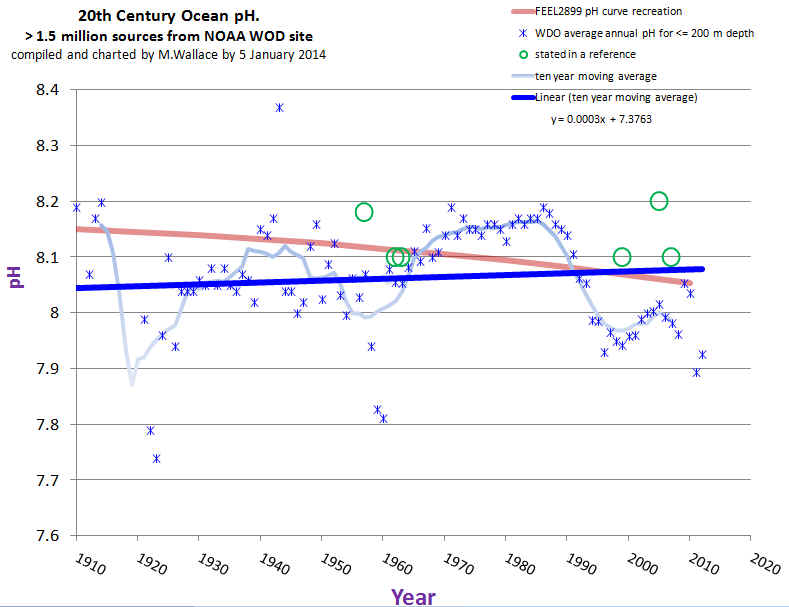
What if Obama’s climate change policies are based on pHraud? The Feely-Sabine ocean acidification ignores 80 years of real-world data that show no acidification trend You are here: Home › All Posts › What if Obama’s climate change policies are based on pHraud? stormyocean December 22, 2014 by Marita Noon, 6 Comments 816 EmailShare “Ocean acidification” (OA) is receiving growing attention. While someone who doesn’t follow climate change science might think OA is a stomach condition resulting from eating bad seafood, OA is claimed to be a phenomenon that will destroy ocean life—all due to mankind’s use of fossil fuels. It is a foundational theory upon which the global warming/climate change narrative is built. feelyThe science and engineering website Quest recently posted: “Since the Industrial Revolution in the late 1700s, we have been mining and burning coal, oil, and natural gas for energy and transportation. These processes release carbon dioxide (CO2) into the atmosphere. It is well established that the rising level of CO2 in our atmosphere is a major cause of global warming. However, the increase in CO2 is also causing changes to the chemistry of the ocean. The ocean absorbs some of the excess atmospheric CO2, which causes what scientists call ocean acidification. And ocean acidification could have major impacts on marine life.” Within the Quest text is a link to a chart by Dr. Richard A. Feely, who is a senior scientist with the Pacific Marine Environmental Laboratory (PMEL)—which is part of the National Oceanic and Atmospheric Administration (NOAA). Feely’s climate-crisis views are widely used to support the narrative. Feely’s four-page report: “Carbon Dioxide and Our Ocean Legacy,” offered on the NOAA website, contains a similar chart. This chart, titled “Historical & Projected pH & Dissolved Co2,” begins at 1850. Feely testified before Congress in 2010—using the same data that show a decline in seawater pH (making it more acidic) that appears to coincide with increasing atmospheric carbon dioxide. In 2010, Feely received the $100,000 cash prize from the Heinz Family Foundation awards (established by Teresa Heinz, wife of Secretary of State John Kerry). The Heinz award site touts Feely’s work: “Ocean acidity is now considered global warming’s ‘evil twin,’ thanks in large measure to Dr. Feely’s seminal research on the changing ocean chemistry and its impact on marine ecosystems.” The December edition of the scientific journal Nature Climate Change features commentary titled: “Lessons learned from ocean acidification research.” However, an inquisitive graduate student presented me with a very different “lesson” on OA research. Mike Wallace is a hydrologist with nearly 30 years’ experience, who is now working on his Ph.D. in nanogeosciences at the University of New Mexico. In the course of his studies, he uncovered a startling data omission that, he told me, “eclipses even the so-called climategate event.” Feely’s work is based on computer models that don’t line up with real-world data—which Feely acknowledged in e-mail communications with Wallace (which I have read). And, as Wallace determined, there are real world data. Feely and his coauthor Dr. Christopher L. Sabine, PMEL Director, omitted 80 years of data, which incorporate more than 2 million records of ocean pH levels. Feely’s chart, first mentioned, begins in 1988—which is surprising, as instrumental ocean pH data have been measured for more than 100 years — since the invention of diagram-co2_emissions (1)the glass electrode pH (GEPH) meter. As a hydrologist, Wallace was aware of GEPH’s history and found it odd that the Feely/Sabine work omitted it. He went to the source. The NOAA paper with the chart beginning in 1850 lists Dave Bard, with Pew Charitable Trust, as the contact. Wallace sent Bard an e-mail: “I’m looking in fact for the source references for the red curve in their plot which was labeled ‘Historical & Projected pH & Dissolved Co2.’ This plot is at the top of the second page. It covers the period of my interest.” Bard responded and suggested that Wallace communicate with Feely and Sabine—which he did over a period of several months. Wallace asked again for the “time series data (NOT MODELING) of ocean pH for 20th Century.” Sabine responded by saying that it was inappropriate for Wallace to question their “motives or quality of our science,” adding that if he continued in this manner, “you will not last long in your career.” He then included a few links to websites that Wallace, after spending hours reviewing them, called “blind alleys.” Sabine concludes the e-mail with: “I hope you will refrain from contacting me again.” But communications did continue for several more exchanges. In an effort to obtain access to the records Feely/Sabine didn’t want to provide, Wallace filed a Freedom of Information Act (FOIA) request. In a May 25, 2013 email, Wallace offers some statements, which he asks Feely/Sabine to confirm: “…it is possible that Dr. Sabine WAS partially responsive to my request. That could only be possible however, if only data from 1989 and later was used to develop the 20th century portion of the subject curve.” “…it’s possible that Dr. Feely also WAS partially responsive to my request. Yet again, this could not be possible unless the measurement data used to define 20th Century ocean pH for their curve, came exclusively from 1989 and later (thereby omitting 80 previous years of ocean pH 20th century measurement data, which is the very data I’m hoping to find).” Sabine writes: “Your statements in italics are essentially correct.” He adds: “The rest of the curve you are trying to reproduce is from a modeling study that Dr. Feely has already provided and referenced in the publication.” In his last e-mail exchange, Wallace offers to close out the FOIA because the e-mail string “clarified that your subject paper (and especially the ‘History’ segment of the associated time series pH curve) did not rely upon either data or other contemporary representations for global ocean pH over the period of time between the first decade of 1900 (when the pH metric was first devised, and ocean pH values likely were first instrumentally measured and recorded) through and up to just before 1988.” Wallace received no reply, but the FOIA was closed in July 2013 with a “no document found” response. Interestingly, in this same general timeframe, NOAA reissued its World Ocean Database. Wallace was then able to extract the instrumental records he sought and turned the GEPH data into a meaningful time series chart, which reveals that the oceans are not acidifying. (For another day, Wallace found that the levels coincide with the Pacific Decadal Oscillation.) As Wallace emphasized: “there is no global acidification trend.” pHmeter “In whose professional world,” Wallace asks, “is it acceptable to omit the majority of the data and also to not disclose the omission to any other soul or Congressional body?” Wallace met with staffers for both of his Senators, Martin Heinrich and Tom Udall (both NM-D), and shared his findings with them — but got no response. Heinrich and Udall both claim adherence to the climate crisis narrative. These taxpayer-funded scientists are leaders of the OA narrative. They participate in well-funded OA research programs and sit on advisory councils, such as the Wendy Schmidt Ocean Health X Prize that offers a $2 million prize related to ocean pH measurements. “It all seems authentic and quite legitimate.” Yet their work is based on, as Wallace calls it, “a new history of ocean pH” — one that “is significantly different from the history suggested by actual measurements and other sources of peer review literature.” Wallace came to me, because I’ve addressed similar cases of data omissions or use of bad science in relation to climate change issues, and he hoped I’d see the importance of his discovery—where his Senators did not. I am not a scientist, but I understand the broader issues. I’ve read through the e-mails, the FOIA, and Wallace’s recounting of the details. I’ve had several scientists review this accounting. It holds water (no pun intended). As he initially did with Wallace, Sabine (should he see this) will likely dismiss me as some two-bit blogger who “will not last long” in my career. I invite him to prove me wrong—as Dr. Tim Ball has done with Michael Mann of the “hockey stick” fame. In addition to my efforts to raise awareness of this issue, Wallace authored a petition that he urges my readers to sign. We also strongly encourage you to ask your representatives in Washington questions on this issue. Wallace concludes: “Ocean acidification may seem like a minor issue to some, but besides being wrong, it is a crucial leg to the entire narrative of ‘human-influenced climate change.’ By urging our leaders in science and policy to finally disclose and correct these omissions, you will be helping to bring honesty, transparency, and accountability back where it is most sorely needed.” - See more at: http://www.cfact.org/2014/12/22/what-if-obamas-climate-change-policies-are-based-on-phraud/#sthash.u9OTwJV7.dpuf

What if Obama’s climate change policies are based on pHraud?

What if Obama’s climate change policies are based on pHraud?


What if Obama’s climate change policies are based on pHraud?

The Feely-Sabine ocean acidification ignores 80 years
of real-world data that show no acidification trend


by , 6 Comments
·                                                                        

“Ocean acidification” (OA) is
receiving growing attention. While someone who doesn’t follow climate change
science might think OA is a stomach condition resulting from eating bad
seafood, OA is claimed to be a phenomenon that will destroy ocean life—all due
to mankind’s use of fossil fuels. It is a foundational theory upon which the
global warming/climate change narrative is built.
The
science and engineering website Quest recently posted:
“Since the Industrial Revolution in the late 1700s, we have been mining and
burning coal, oil, and natural gas for energy and transportation. These
processes release carbon dioxide (CO2) into the atmosphere. It is well
established that the rising level of CO2 in our atmosphere is a major cause of
global warming. However, the increase in CO2 is also causing changes to the
chemistry of the ocean. The ocean absorbs some of the excess atmospheric CO2,
which causes what scientists call ocean acidification. And ocean acidification
could have major impacts on marine life.”
Within the Quest text is a link to
a chart
by Dr. Richard
A. Feely
, who is a senior scientist with the Pacific Marine
Environmental Laboratory (PMEL)—which is part of the National Oceanic and
Atmospheric Administration (NOAA). Feely’s climate-crisis views are widely used
to support the narrative.
Feely’s four-page report: “Carbon
Dioxide and Our Ocean Legacy,” offered on
the NOAA website, contains a similar chart. This chart, titled “Historical
& Projected pH & Dissolved Co2,” begins at 1850. Feely testified
before Congress in 2010—using the same data that show a decline in seawater pH
(making it more acidic) that appears to coincide with increasing atmospheric
carbon dioxide.
In 2010, Feely received
the $100,000 cash prize from the Heinz Family Foundation awards (established by
Teresa Heinz, wife of Secretary of State John Kerry).
The Heinz award site touts Feely’s
work: “Ocean acidity is now considered global warming’s ‘evil twin,’ thanks in
large measure to Dr. Feely’s seminal research on the changing ocean chemistry
and its impact on marine ecosystems.”
The December edition of the
scientific journal Nature Climate Change features commentary
titled: “Lessons learned from ocean acidification research.”
However, an inquisitive graduate
student presented me with a very different “lesson” on OA research.
Mike Wallace is a
hydrologist with nearly 30 years’ experience, who is now working on his Ph.D.
in nanogeosciences at the University of New Mexico. In the course of his
studies, he uncovered a startling data omission that, he told me, “eclipses
even the so-called climategate
event.”
Feely’s work is based on computer
models that don’t line up with real-world data—which Feely acknowledged in
e-mail communications with Wallace (which I have read). And, as Wallace
determined, there are real world data. Feely and his coauthor Dr. Christopher L.
Sabine
, PMEL Director, omitted 80 years of data, which incorporate
more than 2 million records of ocean pH levels.
Feely’s chart, first mentioned,
begins in 1988—which is surprising, as instrumental ocean pH data have been
measured for more than 100 years — since the invention of the glass electrode pH (GEPH)
meter. As a hydrologist, Wallace was aware of GEPH’s history and found it odd
that the Feely/Sabine work omitted it. He went to the source. The NOAA paper
with the chart beginning in 1850 lists Dave Bard, with Pew
Charitable Trust, as the contact.
Wallace sent Bard an e-mail: “I’m
looking in fact for the source references for the red curve in their plot which
was labeled ‘Historical & Projected pH & Dissolved Co2.’
This plot is at the top of the second page. It covers the period of my
interest.” Bard responded and suggested that Wallace communicate with Feely and
Sabine—which he did over a period of several months. Wallace asked again for
the “time series data (NOT MODELING) of ocean pH for 20th Century.”
Sabine responded by saying that it
was inappropriate for Wallace to question their “motives or quality of our
science,” adding that if he continued in this manner, “you will not last long
in your career.” He then included a few links to websites that Wallace, after
spending hours reviewing them, called “blind alleys.”  Sabine concludes
the e-mail with: “I hope you will refrain from contacting me again.” But
communications did continue for several more exchanges.
In an effort to obtain access to
the records Feely/Sabine didn’t want to provide, Wallace filed a Freedom of
Information Act (FOIA) request.
In a May 25, 2013 email, Wallace
offers some statements, which he asks Feely/Sabine to confirm:
“…it is possible that Dr.
Sabine WAS partially responsive to my request. That could only be possible
however, if only data from 1989 and later was used to develop the 20th century
portion of the subject curve.
“…it’s possible that Dr. Feely
also WAS partially responsive to my request. Yet again, this could not be
possible unless the measurement data used to define 20th Century ocean pH for
their curve, came exclusively from 1989 and later (thereby omitting 80 previous
years of ocean pH 20th century measurement data, which is the very data I’m
hoping to find).
Sabine writes: “Your statements in
italics are essentially correct.” He adds: “The rest of the curve you are
trying to reproduce is from a modeling study that Dr. Feely has already
provided and referenced in the publication.”
In his last e-mail exchange,
Wallace offers to close out the FOIA because the e-mail string “clarified that
your subject paper (and especially the ‘History’ segment of the associated time
series pH curve) did not rely upon either data or other contemporary
representations for global ocean pH over the period of time between the first
decade of 1900 (when the pH metric was first devised, and ocean pH values
likely were first instrumentally measured and recorded) through and up to just
before 1988.” Wallace received no reply, but the FOIA was closed in July 2013
with a “no document found” response.
Interestingly, in this same general
timeframe, NOAA reissued its World Ocean Database. Wallace was then able to
extract the instrumental records he sought and turned the GEPH data into a
meaningful time
series chart
, which reveals that the oceans are not acidifying. (For
another day, Wallace found that the levels coincide with the Pacific Decadal
Oscillation.) As Wallace emphasized: “there is no global acidification trend.”
“In whose professional world,”
Wallace asks, “is it acceptable to omit the majority of the data and also to
not disclose the omission to any other soul or Congressional body?”
Wallace met with staffers for both
of his Senators, Martin Heinrich and Tom Udall
(both NM-D), and shared his findings with them — but got no response. Heinrich
and Udall both claim adherence
to the climate crisis narrative.
These taxpayer-funded scientists
are leaders of the OA narrative. They participate in well-funded OA research
programs and sit on advisory councils, such as the Wendy
Schmidt Ocean Health X Prize
that offers a $2 million prize related to
ocean pH measurements. “It all seems authentic and quite legitimate.” Yet their
work is based on, as Wallace calls it, “a new history of ocean pH” — one that
“is significantly different from the history suggested by actual measurements
and other sources of peer review literature.”
Wallace came to me, because I’ve
addressed similar cases of data
omissions
or use of bad
science
in relation to climate change issues, and he hoped I’d see the
importance of his discovery—where his Senators did not. I am not a scientist,
but I understand the broader issues. I’ve read through the e-mails, the FOIA,
and Wallace’s recounting of the details. I’ve had several scientists review
this accounting. It holds water (no pun intended).
As he initially did with Wallace,
Sabine (should he see this) will likely dismiss me as some two-bit blogger who
“will not last long” in my career. I invite him to prove me wrong—as Dr. Tim
Ball
has done with Michael Mann of the “hockey stick”
fame.
In addition to my efforts to raise
awareness of this issue, Wallace authored a petition
that he urges my readers to sign. We also strongly encourage you to ask your
representatives in Washington questions on this issue. Wallace concludes:
“Ocean acidification may seem like a minor issue to some, but besides being
wrong, it is a crucial leg to the entire narrative of ‘human-influenced climate
change.’ By urging our leaders in science and policy to finally disclose and
correct these omissions, you will be helping to bring honesty, transparency,
and accountability back where it is most sorely needed.”
- See more at:
http://www.cfact.org/2014/12/22/what-if-obamas-climate-change-policies-are-based-on-phraud/#sthash.u9OTwJV7.dpuf 


What if Obama’s climate change policies are based on pHraud?

What if Obama’s climate change policies are based on pHraud?


What if Obama’s climate change policies are based on pHraud?

The Feely-Sabine ocean acidification ignores 80 years
of real-world data that show no acidification trend


by , 6 Comments
·                                                                        

“Ocean acidification” (OA) is
receiving growing attention. While someone who doesn’t follow climate change
science might think OA is a stomach condition resulting from eating bad
seafood, OA is claimed to be a phenomenon that will destroy ocean life—all due
to mankind’s use of fossil fuels. It is a foundational theory upon which the
global warming/climate change narrative is built.
The
science and engineering website Quest recently posted:
“Since the Industrial Revolution in the late 1700s, we have been mining and
burning coal, oil, and natural gas for energy and transportation. These
processes release carbon dioxide (CO2) into the atmosphere. It is well
established that the rising level of CO2 in our atmosphere is a major cause of
global warming. However, the increase in CO2 is also causing changes to the
chemistry of the ocean. The ocean absorbs some of the excess atmospheric CO2,
which causes what scientists call ocean acidification. And ocean acidification
could have major impacts on marine life.”
Within the Quest text is a link to
a chart
by Dr. Richard
A. Feely
, who is a senior scientist with the Pacific Marine
Environmental Laboratory (PMEL)—which is part of the National Oceanic and
Atmospheric Administration (NOAA). Feely’s climate-crisis views are widely used
to support the narrative.
Feely’s four-page report: “Carbon
Dioxide and Our Ocean Legacy,” offered on
the NOAA website, contains a similar chart. This chart, titled “Historical
& Projected pH & Dissolved Co2,” begins at 1850. Feely testified
before Congress in 2010—using the same data that show a decline in seawater pH
(making it more acidic) that appears to coincide with increasing atmospheric
carbon dioxide.
In 2010, Feely received
the $100,000 cash prize from the Heinz Family Foundation awards (established by
Teresa Heinz, wife of Secretary of State John Kerry).
The Heinz award site touts Feely’s
work: “Ocean acidity is now considered global warming’s ‘evil twin,’ thanks in
large measure to Dr. Feely’s seminal research on the changing ocean chemistry
and its impact on marine ecosystems.”
The December edition of the
scientific journal Nature Climate Change features commentary
titled: “Lessons learned from ocean acidification research.”
However, an inquisitive graduate
student presented me with a very different “lesson” on OA research.
Mike Wallace is a
hydrologist with nearly 30 years’ experience, who is now working on his Ph.D.
in nanogeosciences at the University of New Mexico. In the course of his
studies, he uncovered a startling data omission that, he told me, “eclipses
even the so-called climategate
event.”
Feely’s work is based on computer
models that don’t line up with real-world data—which Feely acknowledged in
e-mail communications with Wallace (which I have read). And, as Wallace
determined, there are real world data. Feely and his coauthor Dr. Christopher L.
Sabine
, PMEL Director, omitted 80 years of data, which incorporate
more than 2 million records of ocean pH levels.
Feely’s chart, first mentioned,
begins in 1988—which is surprising, as instrumental ocean pH data have been
measured for more than 100 years — since the invention of the glass electrode pH (GEPH)
meter. As a hydrologist, Wallace was aware of GEPH’s history and found it odd
that the Feely/Sabine work omitted it. He went to the source. The NOAA paper
with the chart beginning in 1850 lists Dave Bard, with Pew
Charitable Trust, as the contact.
Wallace sent Bard an e-mail: “I’m
looking in fact for the source references for the red curve in their plot which
was labeled ‘Historical & Projected pH & Dissolved Co2.’
This plot is at the top of the second page. It covers the period of my
interest.” Bard responded and suggested that Wallace communicate with Feely and
Sabine—which he did over a period of several months. Wallace asked again for
the “time series data (NOT MODELING) of ocean pH for 20th Century.”
Sabine responded by saying that it
was inappropriate for Wallace to question their “motives or quality of our
science,” adding that if he continued in this manner, “you will not last long
in your career.” He then included a few links to websites that Wallace, after
spending hours reviewing them, called “blind alleys.”  Sabine concludes
the e-mail with: “I hope you will refrain from contacting me again.” But
communications did continue for several more exchanges.
In an effort to obtain access to
the records Feely/Sabine didn’t want to provide, Wallace filed a Freedom of
Information Act (FOIA) request.
In a May 25, 2013 email, Wallace
offers some statements, which he asks Feely/Sabine to confirm:
“…it is possible that Dr.
Sabine WAS partially responsive to my request. That could only be possible
however, if only data from 1989 and later was used to develop the 20th century
portion of the subject curve.
“…it’s possible that Dr. Feely
also WAS partially responsive to my request. Yet again, this could not be
possible unless the measurement data used to define 20th Century ocean pH for
their curve, came exclusively from 1989 and later (thereby omitting 80 previous
years of ocean pH 20th century measurement data, which is the very data I’m
hoping to find).
Sabine writes: “Your statements in
italics are essentially correct.” He adds: “The rest of the curve you are
trying to reproduce is from a modeling study that Dr. Feely has already
provided and referenced in the publication.”
In his last e-mail exchange,
Wallace offers to close out the FOIA because the e-mail string “clarified that
your subject paper (and especially the ‘History’ segment of the associated time
series pH curve) did not rely upon either data or other contemporary
representations for global ocean pH over the period of time between the first
decade of 1900 (when the pH metric was first devised, and ocean pH values
likely were first instrumentally measured and recorded) through and up to just
before 1988.” Wallace received no reply, but the FOIA was closed in July 2013
with a “no document found” response.
Interestingly, in this same general
timeframe, NOAA reissued its World Ocean Database. Wallace was then able to
extract the instrumental records he sought and turned the GEPH data into a
meaningful time
series chart
, which reveals that the oceans are not acidifying. (For
another day, Wallace found that the levels coincide with the Pacific Decadal
Oscillation.) As Wallace emphasized: “there is no global acidification trend.”
“In whose professional world,”
Wallace asks, “is it acceptable to omit the majority of the data and also to
not disclose the omission to any other soul or Congressional body?”
Wallace met with staffers for both
of his Senators, Martin Heinrich and Tom Udall
(both NM-D), and shared his findings with them — but got no response. Heinrich
and Udall both claim adherence
to the climate crisis narrative.
These taxpayer-funded scientists
are leaders of the OA narrative. They participate in well-funded OA research
programs and sit on advisory councils, such as the Wendy
Schmidt Ocean Health X Prize
that offers a $2 million prize related to
ocean pH measurements. “It all seems authentic and quite legitimate.” Yet their
work is based on, as Wallace calls it, “a new history of ocean pH” — one that
“is significantly different from the history suggested by actual measurements
and other sources of peer review literature.”
Wallace came to me, because I’ve
addressed similar cases of data
omissions
or use of bad
science
in relation to climate change issues, and he hoped I’d see the
importance of his discovery—where his Senators did not. I am not a scientist,
but I understand the broader issues. I’ve read through the e-mails, the FOIA,
and Wallace’s recounting of the details. I’ve had several scientists review
this accounting. It holds water (no pun intended).
As he initially did with Wallace,
Sabine (should he see this) will likely dismiss me as some two-bit blogger who
“will not last long” in my career. I invite him to prove me wrong—as Dr. Tim
Ball
has done with Michael Mann of the “hockey stick”
fame.
In addition to my efforts to raise
awareness of this issue, Wallace authored a petition
that he urges my readers to sign. We also strongly encourage you to ask your
representatives in Washington questions on this issue. Wallace concludes:
“Ocean acidification may seem like a minor issue to some, but besides being
wrong, it is a crucial leg to the entire narrative of ‘human-influenced climate
change.’ By urging our leaders in science and policy to finally disclose and
correct these omissions, you will be helping to bring honesty, transparency,
and accountability back where it is most sorely needed.”
- See more at:
http://www.cfact.org/2014/12/22/what-if-obamas-climate-change-policies-are-based-on-phraud/#sthash.u9OTwJV7.dpuf