My Mobile Blog

Friday, June 21, 2019

Unreliable Nature Of Solar And Wind Makes Electricity More Expensive, New Study Finds

Unreliable Nature Of Solar And Wind Makes Electricity More Expensive, New Study Finds


 Unreliable Nature Of Solar And Wind Makes Electricity More Expensive, New Study Finds


Michael Shellenberger


Michael Shellenberger


Contributor 


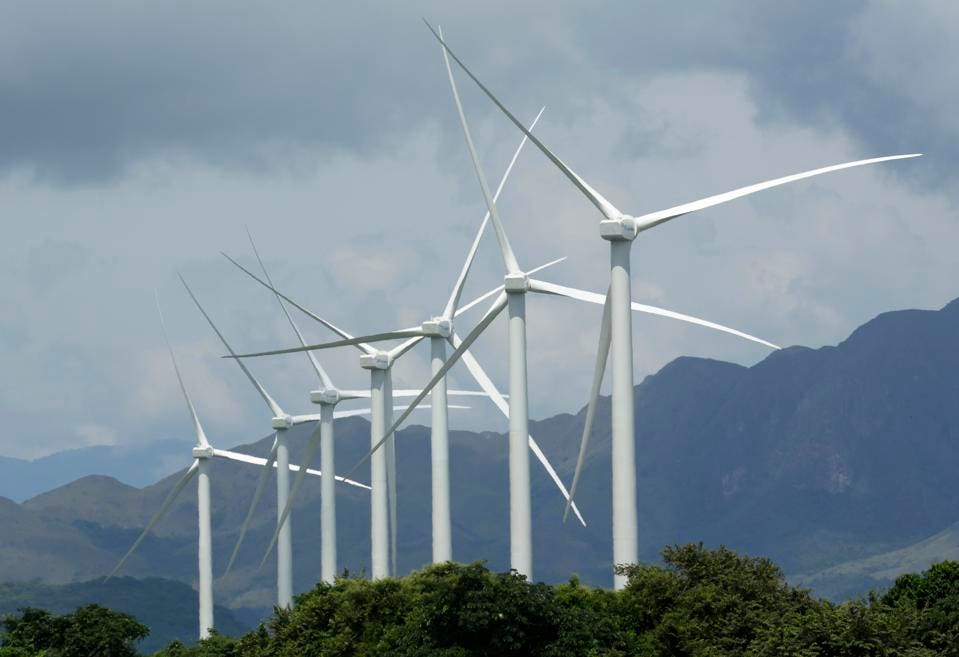
Wind turbines in Penonome, Panama. (Credit: Associated Press)


Wind turbines in Penonome, Panama. (Credit: Associated Press)
Solar panels and wind turbines are
making electricity significantly more expensive, a major new study by a
team of economists from the University of Chicago finds.
Renewable Portfolio Standards (RPS) "significantly increase
average retail electricity prices, with prices increasing by 11% (1.3
cents per kWh) seven years after the policy’s passage into law and 17%
(2 cents per kWh) twelve years afterward," the economists write.


The study, which has yet to go through peer-review, was done by
Michael Greenstone, Richard McDowell, and Ishan Nath. It compared states
with and without an RPS. It did so using what the economists say is
"the most comprehensive state-level dataset ever compiled" which
covered 1990 to 2015.


The cost to consumers has been staggeringly high: "All in all,
seven years after passage, consumers in the 29 states had paid $125.2
billion more for electricity than they would have in the absence of the
policy," they write.


Last year, I was the first journalist to report that solar and wind are making electricity more expensive in the United States — and for inherently physical reasons.


Solar and wind require that natural gas
plants, hydro-electric dams, batteries or some other form of reliable
power be ready at a moment’s notice to start churning out electricity
when the wind stops blowing and the sun stops shining, I noted.


And unreliability requires solar- and/or wind-heavy places like Germany, California, and Denmark to pay neighboring nations or states to take their solar and wind energy when they are producing too much of it.


My reporting was criticized — sort of
— by those who claimed I hadn't separated correlation from causation,
but the new study by a top-notch team of economists, including an
advisor to Barack Obama, proves I was right.


Previous studies were misleading, the economists note, because
they didn't "incorporate three key costs," which are the unreliability
of renewables, the large amounts of land they require, and the
displacement of cheaper "baseload" energy sources like nuclear plants.


The higher cost of electricity reflects "the costs that
renewables impose on the generation system," the economists note,
"including those associated with their intermittency, higher
transmission costs, and any stranded asset costs assigned to
ratepayers."


But are renewables cost-effective climate policy? They are not.
The economists write that "the cost per metric ton of CO2 abated exceeds
$130 in all specifications and ranges up to $460, making it at least
several times larger than conventional estimates of the social cost of
carbon."


The economists note that the Obama Administration’s core estimate
of the social cost of carbon was $50 per ton in 2019 dollars, while the
price of carbon is just $5 in the US northeast’s Regional Greenhouse
Gas Initiative (RGGI), and $15 in California’s cap-and-trade system.


Posted by pgrove at 11:09 AM

Liberals' National Popular Vote Scheme Is Unconstitutional and Dangerous

Liberals' National Popular Vote Scheme Is Unconstitutional and Dangerous


Liberals' National Popular Vote Scheme Is Unconstitutional and Dangerous


By Brian S. Messenger
 

As
of now, fourteen states have passed the National Popular Vote
Interstate Compact (NPVIC), which attempts to eliminate the Electoral
College as set forth in the United States Constitution.  There have been
many good articles written about the legality of interstate compacts
to achieve the desired National Popular Vote goals.  The author does
not need to rehash all of those problems but believes that there are
three additional ways that the NPVIC is both unconstitutional and
dangerous.


Constitutional Flaw #1: Non-Republican Form of Government


Article IV, Section 4 of the United States Constitution says in part that  "[t]he United States shall guarantee to every State
in this Union a Republican Form of Government."  The United States is a
constitutional republic, where people elect their senators and
representatives at the national level.  At the state level, this is
copied by every state except for Nebraska, which has a unique unicameral
Legislature.  A Republican form of government, by its definition, means
that people elect representatives to represent them in running the
government.  This is done so that the people are not encumbered with the
daily operations and voting to run the state or federal government.


A
fundamental problem with the NPVIC is that it is inherently not a
republican form of government for a specific state to select that
state's Electors.  Once a state Legislature decides to ask its citizens
their preference through a popular vote, there must be a rational basis
as to how the vote of the state's citizens is used to select that
state's electors.  It is not rational that the people's decision could
be overruled by the votes of citizens of unrelated states.  The
following comparison is between two states in the NPVIC who are at the
extremes of the Popular Vote Range for the 2016 election.


Vermont
has three electoral votes in our existing system and cast 315,067 votes
for president in 2016.  This constituted 0.23% of the total votes in
the nation.  Under the NPVIC, Vermont will give other states 99.77% of
the power to select its state's electors for president instead of
maintaining the 100% control it presently has.  Presently, there is a
total pool of 538 electors, and 0.23% constitutes 1.2 electors.  Vermont
has irrationally thrown away its automatic control of three Electoral
Votes for an effective control of 1.2 electoral votes.


At
the other extreme is the state of California, which has 55 electoral
votes in the present system.  In the 2016 presidential election, there
were 14,181,595 votes cast for president in California, which
constituted 10.4% of the nation's total votes.  California will give
other states 89.6% of the power to select its state's electors for
president instead of maintaining the 100% control it presently
has.  California has traded 55 electoral votes for an effective 56
electoral votes.  At least California's decision would result in a
higher number of effective electoral votes for the State, but it would
still hand 89.6% of the decision to other states.


Legislatures
of small states are committing a form of legislative malpractice by
joining the NPVIC.  The NPVIC is the latest in a 250-year history of
schemes where the populous states are trying to bully and dominate the
small states in the country.  Under the guise of the perceived
unfairness of specific presidential election outcomes, the large states
are trying to fool the small states into giving up the finely balanced
power they were guaranteed when they joined the United States.  In
addition, as different states implement different rules for voting, all other states would suffer the corruption of the national popular vote by sanctuary states.  Those states allow non-citizens to vote in some elections and/or make it likely that errors will result in ineligible people voting in presidential elections. 


Constitutional Flaw #2: Popular Vote Coercion


In
1824 (the 10th presidential election in U.S. history), there were four
candidates.  More importantly, there were many ways that states selected
their electoral votes.  In the 1824 election, the states of Delaware,
Georgia, Louisiana, New York, South Carolina, and Vermont did not have
any popular votes for president.  At that time, these states had a total
of 71 electoral votes out of a total of 261.  These states used various
approaches to apportion their electors in the manner they felt
best.  For instance, New York had electors vote for the following
candidates: Andrew Jackson (1), John Quincy Adams (26), Henry Clay (4),
and William Crawford (5).


States have significant flexibility in choosing their electors.  A state could have strong antiwar conscientious objector
feelings and decide that it is morally wrong to select the commander in
chief of the Armed Forces.  In this case, the Legislature could devise a
random process to select electors, or select none at all, so as not to
trample on the feelings of their citizens.  Another state could believe
strongly in astrology
and think birth sign is the most important factor in determining a
commander in chief.  Its Legislature could apportion electors using a
formula based on the birth signs of the candidates.  Though the author
hopes these seem extreme to the reader, it could be argued that they
have a rational basis from the perspective of their state legislatures.


Many
states have used methods other than the popular vote to select their
presidential electors in our nation's history.  The NPVIC would force
states to hold popular votes for president or lose power within our
constitutional republic.  This coercion would occur since unless states
held a popular vote, and their votes were added into the national total,
they would lose power relative to the states in the NPVIC.  In the year
2000, the U.S. Supreme Court re-highlighted the right of state
legislatures to select electors through various means in Bush v. Gore.  These approaches included having the state legislatures take back the ability to choose electors from the people.


Constitutional Flaw #3: Removal of Critical Safety Mechanism


In
the last 13 presidential elections, there have been two where a
third-party candidate received more than 10% of the votes: 1968-Wallace
(13.5%) and 1992-Perot (18.9%).  There were an additional two
presidential elections where a third-party candidate received more than
5% of the vote: 1980-Anderson (6.6%) and 1996-Perot (8.4%).  In addition
to the earlier described 1824 election, the 1860 election in the
lead-up to the Civil War had four major candidates.  In the 1860
Election, the percentages of the popular vote were as follows: Lincoln
(39.8%), Douglas (29.5%), Breckinridge (18.1%), and Bell (12.6%).  The
electoral vote percentages that showed popularity by State were very
different: Lincoln (180), Douglas (12), Breckinridge (72), and Bell
(39).  The electoral votes show that even though Douglas had almost 30%
of the national popular vote, he was the least preferred candidate when
states selected their electors.


As
the number of candidates for election increases, the likelihood of
having an extreme candidate receive the most popular votes goes up
dramatically.  Germany held a federal election in November of 1932, and
the results were as follows: National Socialist German Workers Party
(33.1%), Social Democratic Party of Germany (20.4%), Communist Party
(16.9%), Centre Party (11.9%), and the German National People's Party
(8.3%).  If a fifth major candidate had run for president in the United
States in 1824 or 1860, the percentages could have appeared similar.  If
the reader hasn't figured it out yet, the leader of the National
Socialist German Workers Party was Adolf Hitler.  Even though fewer than
one third of all German voters selected the National Socialist German
Workers Party, the NPVIC approach would have automatically made Adolf
Hitler president with no safety mechanism.


The
Electoral College is only part of the genius of the system our founders
created to select a president.  There is a second step involved if no
candidate receives a majority of the electoral votes.  This has happened
twice (1800 and 1824), but the 1824 case is the more
illustrative.  When no candidate receives a majority of the electoral
votes, the election goes to the United States House of
Representatives.  Each state gets a single vote to choose among the top
three recipients of electoral votes, as specified by the 12th Amendment
to the U.S. Constitution.  In 1824, Andrew Jackson had the most popular
votes, and the most electoral votes, but they were not a majority.


In
1824, Andrew Jackson was a political outsider who was eyed with
distrust in Washington.  When the Election of 1824 went to the U.S.
House of Representatives, the states were allowed to identify the best
compromise candidate they could find from the top three electoral vote
recipients.  The U.S. House voted: John Quincy Adams (13),  Andrew
Jackson (7), and William Crawford (4).  John Quincy Adams, the son of
our country's second president, was elected president by the House of
Representatives in 1824.  In spite of losing the 1824 election in the
House of Representatives, Andrew Jackson came back to win the presidency
outright in the Electoral College in 1828 and 1832, and he is honored
on the $20 bill.


Conclusion


In
the 13 presidential elections that the author can remember, he has felt
emotions ranging from being thrilled, being happy, being worried, and
being disgusted with the results.  Since we live in a great country,
where honest Americans can have different views, the author is sure that
many people felt differently.  Unfortunately, the fact that someone
doesn't like who wins specific elections is no excuse for trying to
dramatically change the genius of our presidential election
system.  This paper shows how the NPVIC would not only be
unconstitutional in three key ways, but would potentially be dangerous
to our nation.
Posted by pgrove at 9:55 AM

Thursday, June 20, 2019

A shocking scientific discovery: Winds affect ocean temperatures!

A shocking scientific discovery: Winds affect ocean temperatures!


A shocking scientific discovery: Winds affect ocean temperatures!

By Jack Hellner

I
am shocked to learn that winds affect ocean temperatures.  I am also
surprised to learn from the National Oceanic and Atmospheric
Administration (NOAA) that ocean currents, temperatures around the
Earth, and carbon dioxide levels are all related to the Earth's rotation
and the sun and that the ocean currents are on a 1,000-year cycle.


CNN:


Boaty McBoatface makes significant climate change discovery on first mission


The
British research submarine Boaty McBoatface has made an impressive
debut in the scientific arena, discovering a significant link between
Antarctic winds and rising sea temperatures on its maiden outing.


NOAA writes:


Ocean water is on the move, affecting your climate, your local ecosystem, and the seafood that you eat. Ocean currents,
abiotic features of the environment, are continuous and directed
movements of ocean water. These currents are on the ocean's surface and
in its depths, flowing both locally and globally.


Winds,
water density, and tides all drive ocean currents. Coastal and sea
floor features influence their location, direction, and speed. Earth's
rotation results in the Coriolis Effect which also influences ocean currents.


Large-scale surface ocean currents are
driven by global wind systems that are fueled by energy from the sun.
These currents transfer heat from the tropics to the polar regions,
influencing local and global climate. The warm Gulf Stream originating
in the tropical Caribbean, for instance, carries about 150 times more
water than the Amazon River. The current moves along the U.S. East Coast
across the Atlantic Ocean towards Europe. The heat from the Gulf Stream
keeps much of Northern Europe significantly warmer than other places
equally as far north.


Differences
in water density, resulting from the variability of water temperature
(thermo) and salinity (haline), also cause ocean currents. This process
is known as thermohaline circulation. In cold regions, such as the North
Atlantic Ocean, ocean water loses heat to the atmosphere and becomes
cold and dense. When ocean water freezes, forming sea ice, salt is left
behind causing surrounding seawater to become saltier and denser.
Dense-cold-salty water sinks to the ocean bottom. Surface water flows in
to replace the sinking water, which in turn becomes cold and salty
enough to sink. This "starts" the global conveyer belt,
a connected system of deep and surface currents that circulate around
the globe on a 1000 year time span. This global set of ocean currents is
a critical part of Earth's climate system as well as the ocean nutrient
and carbon dioxide cycles.


Other shocking scientific discoveries:


  • Record snow and rains cause floods. 
  • Record snow causes reservoirs to fill. 
  • Long droughts before the use of petroleum products and fossil fuels caused deserts to form. 
  • The Earth is warmer in the summer and colder in the winter. 
  • People in underdeveloped countries, where fossil fuels and petroleum products are not used as much, die younger. 
Scientific results too often relate to how much money scientists can extract from the government and other sources.


The
climate has always changed naturally throughout millions of years of
history.  Temperatures have risen and fallen.  Ice has come and
gone.  Sea levels rise and fall; droughts come and go.  Floods
happen.  Storm activity fluctuates.  All this has occurred prior to
humans and fossil fuels and has no correlation with whether CO2 has been
higher or lower.


The
indoctrination, supported by almost all the media, is dangerous to our
freedom.  People must be completely ignorant or naïve to believe that
politicians, bureaucrats, and scientists can control temperatures, sea
levels, and storm activity forever if we just hand over trillions of our
hard-earned dollars to them.  The only thing that does is make the very
wealthy D.C. area richer than it already is.


Do
we believe that the government can control the temperature on the sun,
the rotation of the Earth, the ocean currents, and the winds in
Antarctica?  Please explain how.  The politicians who promise they can
control the climate couldn't even keep their promise that we could keep
our doctors and our health plans and that our premiums would go down if
we just let them pass Obamacare. 


Isn't
it time journalists used their brains, common sense, and logic instead
of just repeating what they are told to push an agenda?  Wouldn't the
public trust them more?
Posted by pgrove at 3:34 PM

Friday, June 14, 2019

Can We Arrest Global Warming By Yanking CO2 From The Atmosphere?

Can We Arrest Global Warming By Yanking CO2 From The Atmosphere?


Can We Arrest Global Warming By Yanking CO2 From The Atmosphere?


Ken Silverstein


Ken Silverstein


Contributor 
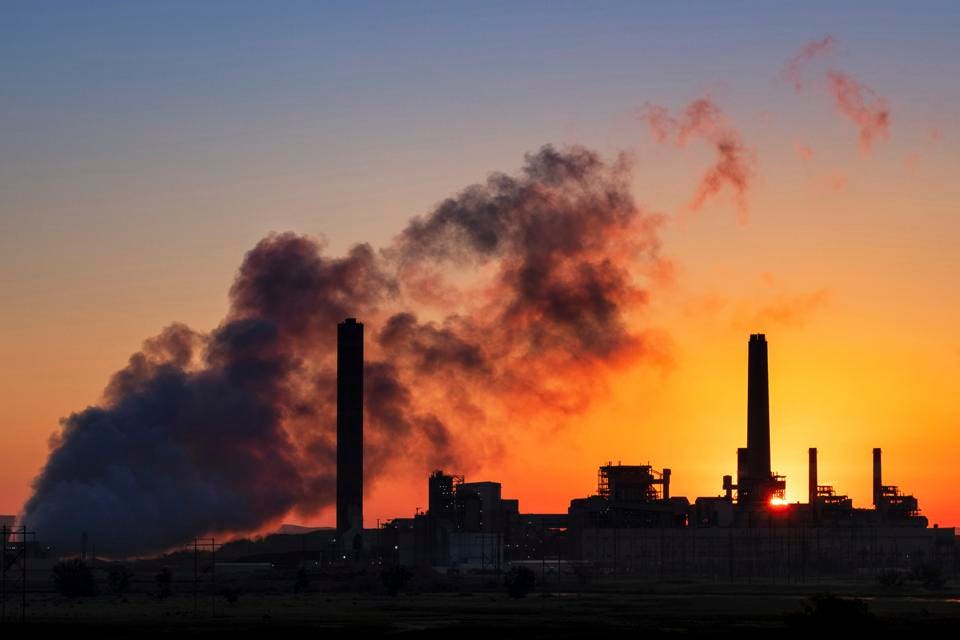
 FILE - In this July 27, 2018, file photo, the Dave Johnson coal-fired power plant is silhouetted against the morning sun in Glenrock, Wyo. Jeremy Grantham, a British billionaire investor who's a major contributor to environmental causes, will fund carbon-capture research in Wyoming, the top U.S. coal-mining state. Wyoming's Republican governor, Mark Gordon, and the carbon-capture technology nonprofit Carbontech Labs announced Thursday, March 28, 2019, they're providing $1.25 million to help researchers find ways to turn greenhouse-gas emissions into valuable products. (AP Photo/J. David Ake, File)


FILE - In this July 27, 2018, file photo,
the Dave Johnson coal-fired power plant is silhouetted against the
morning sun in Glenrock, Wyo. Jeremy Grantham, a British billionaire
investor who's a major contributor to environmental causes, will fund
carbon-capture research in Wyoming, the top U.S. coal-mining state.
Wyoming's Republican governor, Mark Gordon, and the carbon-capture
technology nonprofit Carbontech Labs announced Thursday, March 28, 2019,
they're providing $1.25 million to help researchers find ways to turn
greenhouse-gas emissions into valuable products. (AP Photo/J. David Ake,
File)
ASSOCIATED PRESS
When the National Climate Assessment was
released late last year, it said that the risk of catastrophic climate
change was such that new tools had to be created to literally yank CO2
from atmosphere — to sequester it from ambient air. But what is being
done to achieve this and is this technology feasible?
Study after study has concluded that
climate change is primarily human-induced and that global average
temperatures are the highest they have ever been. And if the level of
heat-trapping emissions is not brought down, it will affect every
dimension of human life — from energy production to water availability to infrastructure development.
“The emitting has gone on so long and has
reached such scale that to avert a 2 degree rise, we need carbon
capture and sequestration to be implemented across the globe,” says Sam
Feinburg, chief operating officer and executive director of Helena that serves as a braintrust to solve climate issues — one that brings together financial, intellectual and political capital.

“We used to ask if this is feasible,” he
continues, in an interview. “Now we know it is imminently feasible but
the bigger question is, ‘will we get there in time.’ “It is very
important that the world embrace this at scale. It is embryonic now. It
will get there. We will accelerate that timeline.”
The 2018 National Climate Assessment
— produced by 13 U.S. agencies — said that to keep temperature rises to
2 degree Celsius and 3.6 degrees Fahrenheit by mid century, public
policy must help facilitate the development of low-to-no-carbon fuels to
power utilities and vehicles.
For those who think the economic cost of such a transition is too high,
think again: The price of inaction, according to the authors, will be
half-trillion dollars a year.

YOU MAY ALSO LIKE

Grads of Life BrandVoice

BrandVoice: Are Workers Ready For Skills Training? The Problem With Seeking Growth Before Stability

UNICEF USA BrandVoice

UNICEF Is Bringing Malnourished Children Back To Life In Yemen

Civic Nation BrandVoice

Civic Nation BrandVoice: Finding My Way To Spelman Through Higher Education

Helena is specifically working with Swiss-based Climeworks to scrub CO2 from the atmosphere — after it has left the smokestack. Climeworks’ goal is
to remove 1% of the world’s total annual CO2 emissions by 2025 — or 10
billion tons of CO2 each year by 2050. Right now, the CO2 that the
company is capturing is re-used for plant life. But if it is to have a
real impact on mitigating the effects of climate change, that CO2 must
be sequestered underground. And that’s hard right now because it cost
$600 to remove a ton of CO2. But Climeworks says it will get that down
to $100 a ton in a few years.


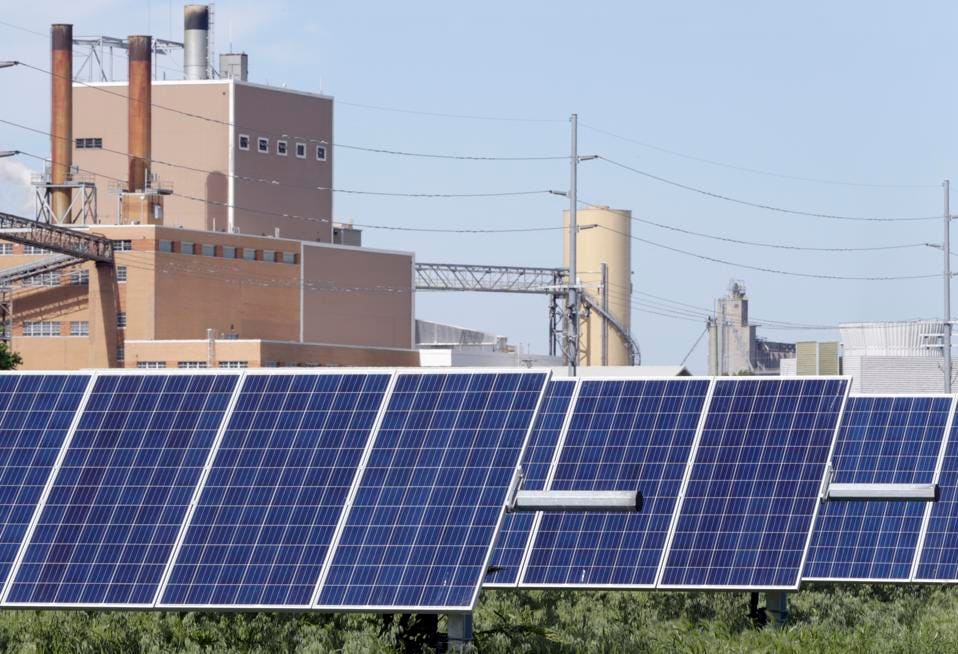
In this May 31, 2018, photo, a solar panel array collects sun light with the Fremont, Neb., with a power plant seen behind it. Solar energy is gaining traction in a small but growing number of Nebraska cities, but the technology still faces a number of obstacles that is keeping it from spreading faster. (AP Photo/Nati Harnik)


In this May 31, 2018, photo, a solar panel
array collects sun light with the Fremont, Neb., with a power plant
seen behind it. Solar energy is gaining traction in a small but growing
number of Nebraska cities, but the technology still faces a number of
obstacles that is keeping it from spreading faster. (AP Photo/Nati
Harnik)
ASSOCIATED PRESS
Catalytic Effect
“The technology needs a catalytic effect: folks must be able to bet on it,” says Henry Elkus, chief executive of Helena,
in an interview. “There is an amount of research and development that
needs to happen to drop the price of a ton of carbon to reach
feasibility. Helena can facilitate that time span.
“We have seen this with solar,” he
continues. “There was a time when it was not viable and now it is.
Carbon capture deserves to be adopted.”
Helena has been working with Climeworks
for two years, providing it with the experts who give consulting and
scientific advice — without taking a financial position. The company, in
fact, has been listed as a “Top 20” in the field of carbon capture,
along with: ExxonMobil, Occidental Petroleum, General Electric,
Mitsubishi Heavy Industries, Schlumberger, Royal Dutch Shell and NRG
Energy. Meanwhile, two of Climeworks competitors that are also focused
on pulling CO2 from the atmosphere are listed: Global Thermostat and
Carbon Engineering.
To be clear, Helena is focused on real
climate solutions — ones that also include the increasing use of
renewable energies. To that end, the Bloomberg Foundation
has just launched a “Beyond Carbon” campaign that is financed with a
$500 million investment. It will work with state and local organizations
to pass laws to get to 100% clean energy by, in part, expanding
low-carbon transit, cleaning up buildings and promoting low-carbon
manufacturing.
The same foundation has worked to close
the nation’s coal plants, with 289 of the 530 being mothballed since
2011. It aims to close the rest by 2030. But it says that replacing that
fuel with natural gas will do little to dent the carbon threat over the
long term, meaning that such energy should be replaced with cleaner
alternatives.
Natural gas,
though, is used to firm up wind and solar plants when the weather does
not permit. And it has helped accelerate the growth of those fuels by
preventing outages. That means that carbon capture is a technology that
should not be forsaken — especially because this country will continue
to use natural gas while the developing world will continue to rely on
coal.
“The goal is to arrest global warming,”
says Helena’s Feinburg. “It is about getting carbon capture to a
commercial and industrial scale. We are about accelerating the growth
curve and adoption of the technology.”
Carbon capture
is an expensive tool that will require new resources to bring it to
fruition. And while many will argue that those monies would be better
targeted to prevailing cleaner fuels, the reality is that the world will
still depend on fossil fuels. The development of the technology is
henceforth unavoidable if we are to meet the challenges presented by
climate change.
Posted by pgrove at 11:28 AM

Great Lakes Reveal a Fatal Flaw in Climate Change ‘Science’

Great Lakes Reveal a Fatal Flaw in Climate Change ‘Science’ 


Great Lakes Reveal a Fatal Flaw in Climate Change ‘Science’

I & I Editorial Board
I & I Editorial


Lake Erie and Lake Superior — two of the five
that make up the Great Lakes — broke records for water levels this May.
Lakes Michigan and Huron could follow suit.
Naturally, climate change is getting the blame. “We are undoubtedly
observing the effects of a warming climate in the Great Lakes,” says
Richard Rood, a University of Michigan climate scientist.


But just a few years ago, climate scientists were insisting that a warming climate would cause water levels to decline.


In 2008, Science Daily
reported on a study that attributed the decline in Great Lakes water
levels to global warming. The researchers who conducted the study said
that the drop “raised concern because the declines are consistent with
many climate change predictions.”


In 2009, Columbia University’s Earth Institute
informed us that “most climate models suggest that we may see declines
in lake levels over the next 100 years; one suggests that we may see
declines of up to 8.2 feet.”


In 2011, the Union of Concern Scientists said
that “scientists expect water levels in the Great Lakes to drop in both
summer and winter, with the greatest declines occurring in Lakes Huron
and Michigan.”


In 2013, the Natural Resources Defense Council said that “it’s no secret that, partially due to climate change, the water levels in the Great Lakes are getting very low.”


That same year, Think Progress reported
that “Several different climate models for the Great Lakes region all
predict that lake levels will decline over the next century.”


Since the Great Lakes account for 21% of the world’s surface fresh
water, these stories were all wrapped in doom-and-gloom scenarios about
the impact on drinking water, shipping, recreation, and so on.


The very next year, however, water levels started rising.


So what are scientists saying now? Simple. They’re now claiming that the fall and rise of Great Lakes’ water levels are due to climate change.


“Climate change is driving rapid shifts between high and low water levels on the Great Lakes,” is the new “consensus.” 


The truth, of course, is that water levels in the Great Lakes vary
over time. And, as a matter of fact, they varied far more in the past
than they do now. A U.S. Geological Survey notes that “prehistoric levels exceed modern-day fluctuations.”


It says that “Prehistoric variations in lake levels have exceeded by
as much as a factor of 2 (that is, more than 3 meters) the 1.6-meter
fluctuation that spanned the 1964 low level and the 1985-87 high
level.”


And, as anyone who’s ever lived near the Great Lakes knows, the lakes themselves were formed
in the wake a massive change in the earth’s climate — when the glaciers
receded at the end of the Ice Age roughly 14,000 years ago.


So if the lakes’ huge fluctuations in the past weren’t caused by
mankind’s burning fossil fuels, why are scientists so convinced that the
far more minor changes happening today are?


The reason is simple. Climate scientists can blame anything they want
on global warming. The climate models are imprecise enough that no
matter what is happening they can point to it as proof that man-made
climate change is happening. Too much rain, too little rain, bitterly
cold winters, mild winters, more snow, less snow, rising water levels,
falling water levels — they can attribute “climate change” as a cause of
it all.


But if nothing can disprove a theory, and every event, no matter how
contradictory, is proof that the theory is valid, is that really
science? Sounds more like a religion to us.
Posted by pgrove at 11:27 AM

Thursday, June 13, 2019

EDITORIAL: Gov. Polis budget splurges on 5-year-old children


EDITORIAL: Gov. Polis budget splurges on 5-year-old children


The sucking sound of big state spending conjures visions of straws — the plastic kind politicians ban in California. Full Democratic command of Colorado, Republicans warn, makes us California East.
“Would you sign a bill banning plastic straws?” we asked Gov. Jared Polis during a phone conversation Tuesday. “Everyone is talking about it.”
“No one is talking about it,” the newly elected Democrat replied, chuckling at our expense, and declining to answer “yes” or “no.”
The businessman-turned-politician prefers small talk about that little matter of a $1.2 billion budget surplus generated by economic growth and the soaring housing market.
Because of rising home values, mill levies are generating more money for local schools and saving the state hundreds of millions that contribute to the surplus.
State law requires government return a percentage of surplus money directly to taxpayers, based on a boring formula involving population growth and inflation. Under that equation, the state will keep hundreds of millions this year.
It won’t build highways. Our new liberal governor — brace for it — would give these mega-millions to 5 year olds.
Seriously, it’s not an awful idea. Kindergarten-for-all would function like a major tax cut for tens of thousands of Colorado parents. Their children, Polis reminds us, comprise our economic future and tax base.
About 13,000 Colorado children skip kindergarten each year because their parents cannot afford tuition. Approximately 30,000 attend kindergarten at a cost to their parents of $400-$500 a month or more. Under Polis budget plan, all could attend and none would have to. It’s a decision for households to make, minus the economic obstacle.
Using surplus dollars, the governor’s budget includes $227 million to provide “full-day kindergarten to every child, instead of the half-day kindergarten the state currently funds.”
That means parents will have between $3,500 and $5,000 more to spend each year, or to save, on something other than kindergarten. Polis hopes they might invest it in other educational options for their kids, such as college tuition or business startups for themselves or their offspring.
Polis believes the $227 million will free up $100 million some school districts use to subsidize full-day kindergarten. They can redirect that money to increase teacher pay and reduce class sizes, he explains.
Bull markets don’t last forever, so Polis proposes putting $90 million of surplus cash in the general fund’s reserve account and $92 million in the state education fund’s savings account.
To begin delivering on health care, the Polis budget sets aside $1.3 million to design a program that would allow Colorado to import lower-priced prescription drugs from Canada. He proposes a Saving People Money on Healthcare Office through the lieutenant governor’s office, to help Coloradans buy insurance through the state. We will analyze the governor’s health care policies more in detail as they transpire.
We would prefer surplus money first go to upgrade deteriorating highways and bridges. But that’s not what Polis ran on. He promised kindergarten and health care, and won by a commanding 10.7 percent margin. Voters made their wishes clear by electing him, while trouncing two ballot measures to fund transportation — one with a tax increase; the other with debt and general fund revenues.
The governor wastes no time trying to deliver on his two most high-profile campaign items. He insists these measures will grow the economy and we hope he is right.
In addition to health care and kindergarten, then-candidate Polis promised pursuit of a 3 to 5 percent income-tax reduction. Given the tax-cutting goal, voters should balk if Polis, legislators or petitioners propose another tax to fix our roads.
Yet, our roads are dangerous, deadly and inefficient. Polis and the Legislature must find a way to fix them at a much faster pace, without new taxes, regardless of commitments to health care and education. That means making difficult decision and dedicating any additional growth in the surplus to transportation first. Lead the way to a transportation system appropriate for the 21st century.
Grow the surplus, not the tax rate, and make Colorado the shining example economic growth benefiting all. Make it the non California, with “California East” a strawman the past.
Posted by pgrove at 5:26 AM

Exclusive: The Pentagon’s Massive Accounting Fraud Exposed

How US military spending keeps rising even as the Pentagon flunks its audit.

By Dave Lindorff

November 27, 2018


Pentagon
An aerial view of the Pentagon building in Washington. (Reuters / Jason Reed)

Ready to fight back?

Sign up for Take Action Now and get three actions in your inbox every week.
You will receive occasional promotional offers for programs that support The Nation’s journalism. You can read our Privacy Policy here.
Posted by pgrove at 5:25 AM
Newer Posts Older Posts Home
Subscribe to: Posts (Atom)

Followers

Blog Archive

  • ▼  2019 (15)
    • ▼  June (15)
      • Insider Blows Whistle & Exec Reveals Googl...
      • Why the “National Popular Vote” scheme is unconsti...
      • Electoral College Rules Made Simple (or, rather, l...
      • Why Did the Framers Create the Electoral College?—...
      • EPA replaces failed Clean Power Plan
      • Unreliable Nature Of Solar And Wind Makes Electric...
      • Liberals' National Popular Vote Scheme Is Unconsti...
      • A shocking scientific discovery: Winds affect ocea...
      • Can We Arrest Global Warming By Yanking CO2 From T...
      • Great Lakes Reveal a Fatal Flaw in Climate Change ...
      • EDITORIAL: Gov. Polis budget splurges on 5-year-ol...
      • Exclusive: The Pentagon’s Massive Accounting Frau...
      • Judging by Mueller's staffing choices, he may not ...
      • Transgenderism vs. Free Speech in BC
      • Global Warming: Media Ignore Sharp Drop In Global ...
  • ►  2018 (14)
    • ►  October (4)
    • ►  September (1)
    • ►  July (2)
    • ►  June (4)
    • ►  May (3)
  • ►  2017 (47)
    • ►  November (8)
    • ►  September (39)
  • ►  2016 (23)
    • ►  October (6)
    • ►  July (10)
    • ►  June (1)
    • ►  May (2)
    • ►  January (4)
  • ►  2015 (7)
    • ►  December (1)
    • ►  April (2)
    • ►  March (4)
  • ►  2014 (10)
    • ►  December (10)
  • ►  2013 (1)
    • ►  November (1)
  • ►  2012 (2)
    • ►  September (1)
    • ►  May (1)
  • ►  2011 (3)
    • ►  December (1)
    • ►  March (2)
  • ►  2010 (5)
    • ►  July (2)
    • ►  May (1)
    • ►  February (2)
  • ►  2009 (17)
    • ►  October (3)
    • ►  September (8)
    • ►  August (6)

About Me

pgrove
View my complete profile

AddThis

Bookmark and Share